

When most people think of franchising, they picture a storefront. They imagine inventory, supply chains, staffing schedules, and foot traffic driving daily revenue. For decades, that image accurately reflected what it meant to buy into a proven system.
But franchising has evolved, along with the way professionals work, connect, and build businesses.
Today, a growing number of franchise models create value without relying on physical products or high-overhead retail spaces. Instead, they are built around something far more durable: relationships. These are community-based franchises, and they are increasingly attractive to experienced professionals looking for a different path to ownership.
Rather than generating value from transactions alone, community-based franchising centers on participation, trust, and shared outcomes. It prioritizes leadership over logistics and long-term engagement over one-time sales, making it especially compelling for individuals whose careers have been built on influence, credibility, and connection.
What Is a Community-Based Franchise?
At its core, a community-based franchise is a business where the primary source of value comes from an engaged group of members, participants, or professionals, not from individual, one-time transactions.
In this model, the franchise owner isn’t selling a product to a passing customer. Instead, they are facilitating an environment where people achieve meaningful outcomes through ongoing participation. The “product” is the community itself: the structure, the standards, and the system that allows members to succeed together.
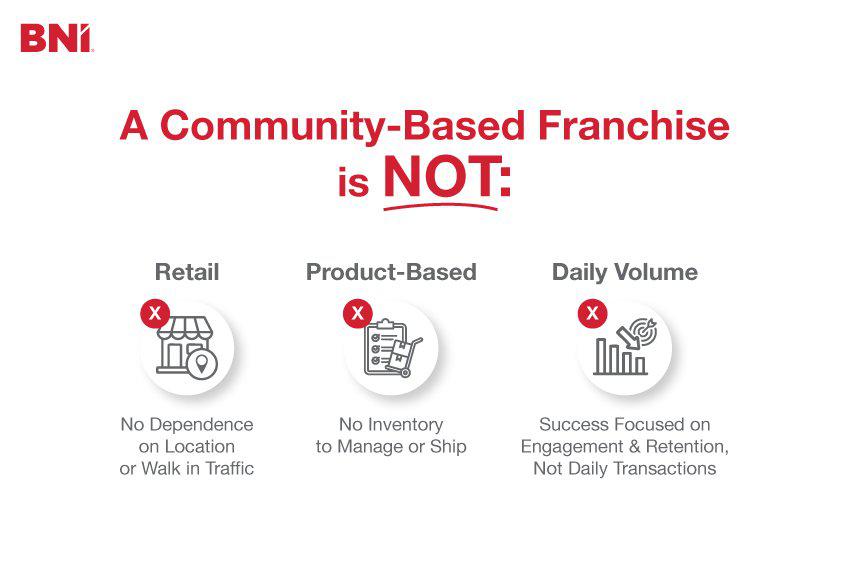
That distinction matters. A community-based franchise is not:
- Retail: It does not depend on location visibility or walk-in traffic.
- Product-based: There is no inventory to manage, ship, or replace.
- Driven by daily volume: Success is measured by engagement and retention over time, not how many transactions occur in a single day.
In a relationship-based franchise, the community is the engine of the business. The owner’s role is to guide that engine, maintain quality, foster engagement, and ensure consistency as the network grows.
How Community-Based Franchises Differ From Traditional Models
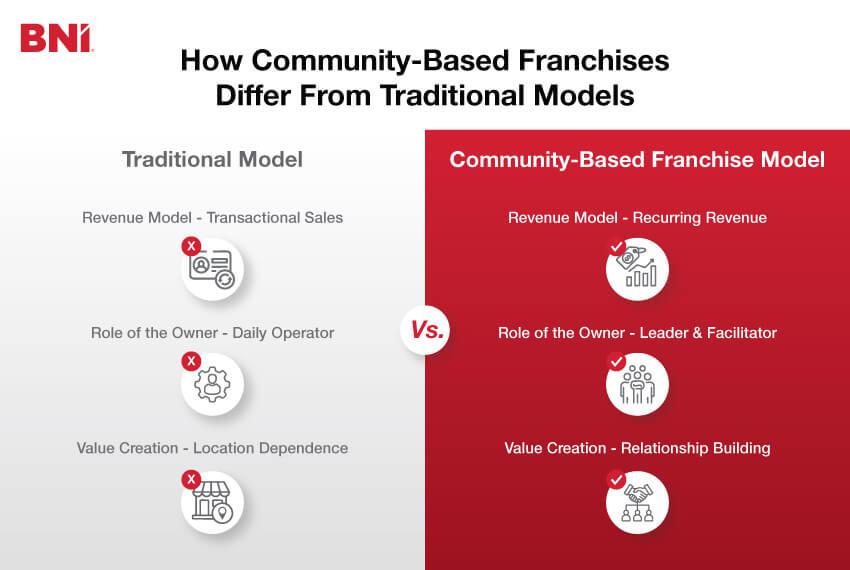
While both traditional franchises and community-based franchises offer the benefit of a proven system, they operate on fundamentally different mechanics. Understanding those differences helps clarify why many professionals gravitate toward this model.
Revenue Model
Traditional franchises often depend on high-volume, transactional sales. Performance is tied to constant customer acquisition. Community-based franchises typically operate on a recurring or membership-driven model, where growth comes from retention and long-term participation. Value compounds over time rather than resetting each month.
The Role of the Owner
In many food or retail franchises, the owner functions primarily as an operator, overseeing staff, schedules, and physical execution. In a community-based franchise, the owner acts as a leader and facilitator. They guide professional peers, set standards, and cultivate outcomes rather than managing day-to-day operations.
Asset Creation
Traditional franchises build equity through infrastructure and location. Community-based franchises build value through reputation, relationships, and the strength of the network itself. The durability of the business is tied to the depth and stability of the community the owner has developed.
Why Professionals Are Gravitating Toward Community-Based Models
For experienced professionals, sales leaders, consultants, and corporate executives, community-based franchising aligns naturally with the skills they’ve spent years refining.
Many reach a point where they want ownership and scalability without taking on operational complexity. They are not interested in managing inventory, maintaining equipment, or overseeing large hourly workforces. Instead, they want a business model that leverages their credibility, leadership, and ability to connect people.
Community-based franchises offer that alignment. Rather than relying on constant prospecting or transactional selling, owners build ecosystems where value is created through participation. The role shifts from selling to facilitating, from convincing to leading.
For many, this feels less like a career change and more like a career progression. It allows professionals to apply their experience at scale while building an asset that extends beyond their individual time and effort.
The Role of Leadership in a Community-Based Franchise
Ownership in a community-based franchise is less about hierarchy and more about stewardship. The franchise owner isn’t simply running a business; they are leading a network of professionals.
That leadership shows up in several ways: establishing expectations, reinforcing culture, and ensuring that members remain engaged and supported. Successful owners also focus on developing other leaders within the community, creating resilience and continuity as the network grows.
This emphasis on coaching, accountability, and consistency is why the model resonates so strongly with individuals who have held senior leadership or advisory roles. High-performing communities do not happen by chance, they are built intentionally, supported by structure and clear standards.
Why Community Creates Built-In Momentum
One of the defining economic advantages of a relationship-based franchise is the momentum created by the community itself.
In transactional businesses, each period often begins from zero. In community-based models, retention provides stability. Members remain engaged because the value they receive increases over time as trust deepens and relationships strengthen.
As outcomes improve, members naturally become advocates for the community. Peer-to-peer success stories reinforce participation and attract new members organically. Over time, this dynamic reduces reliance on traditional marketing and creates a self-reinforcing growth cycle rooted in results rather than promotion.
A Real-World Example of a Community-Based Franchise
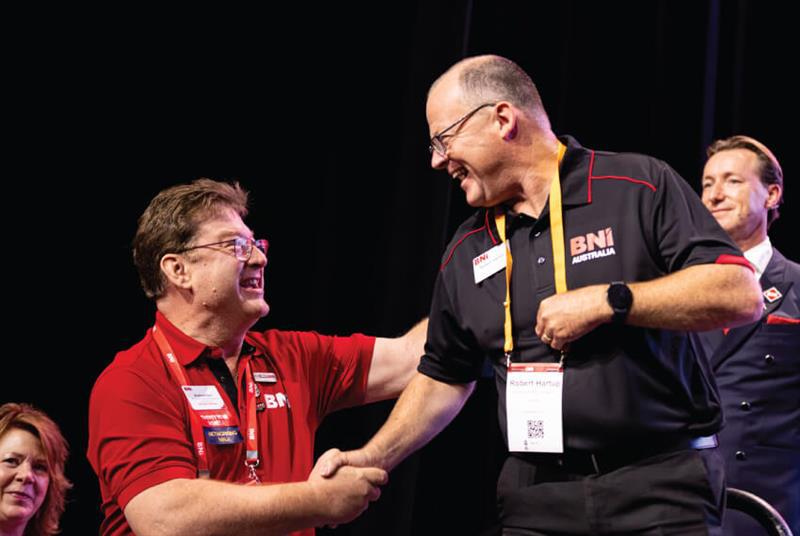
A clear illustration of this model in practice is BNI Franchise.
BNI is a franchise built entirely around professional community and structured referrals. In this model, local chapters are the core offering. Franchise owners do not sell or provide referrals directly; instead, they provide the framework, training, and global systems that enable members to generate business for one another.
The franchise combines centralized support with local leadership. Owners create the conditions for success, while members drive outcomes through participation. It demonstrates how a structured community, when supported by consistent systems, can produce meaningful results without physical inventory or storefronts.
How Community-Based Franchises Scale Without Losing the Human Element
A common question about relationship-driven businesses is whether they can scale without becoming impersonal.
Community-based franchises scale by replicating leadership and systems rather than relying on individual effort alone. Clear frameworks allow local leaders to operate consistently while preserving culture and quality. Standards are maintained, expectations are clear, and the experience remains cohesive, even as the network expands geographically.
This approach allows franchise owners to grow beyond direct involvement in every interaction, transitioning from individual contributor to architect of a scalable system.
Is a Community-Based Franchise Right for You?
Community-based franchising is not about replacing one model with another, it’s about alignment. This type of ownership tends to resonate with professionals who:
- Enjoy leading and developing people
- Value long-term relationships over short-term transactions
- Prefer retention and consistency to constant acquisition
- Are comfortable operating within a proven framework
Understanding how you prefer to lead and create value is an important part of evaluating any franchise opportunity.
A Different Kind of Franchise Ownership
Community-based franchising represents a distinct approach to ownership, one centered on people, participation, and performance rather than products and foot traffic.
For professionals who have built careers on trust, credibility, and connection, this model offers a way to scale those strengths into a durable business. It’s not a replacement for traditional franchising, but an evolution of it, designed for leaders who believe that relationships are not just a soft skill, but a powerful economic driver.