

Is Franchise Ownership Right for You in 2026?
As we approach 2026, the traditional view of career stability is undergoing a profound transformation. The concept of working for a single company for decades has been replaced by a dynamic, often unpredictable economic landscape. For many professionals, this shift isn’t a cause for panic, it is an invitation to pivot.
You might be rethinking what genuine job security looks like. Perhaps you are seeking greater flexibility, control over your income, or a way to build an asset rather than just drawing a salary. This “economic reset” mindset has led many people to consider owning a franchise as a designed, strategic path forward.
Franchising offers a bridge between the freedom of entrepreneurship and the structure of a proven business model. But is it the right move for you? Let’s pressure-test whether exploring franchise ownership is your strategic move for the coming year.
What’s Driving the Surge in Franchise Interest Heading into 2026?
Professionals are exploring franchise opportunities for more than simple financial ambition: there is a collective desire for autonomy that traditional employment struggles to satisfy.
First, corporate fatigue and restructuring have made some high-level executives realize that their titles do not guarantee security. Second, the rise of the “portfolio career” creates an environment where smart operators want to run a business alongside other investments or consulting work. Finally, as AI and technology shift the nature of traditional jobs, there is a premium placed on businesses that rely on human connection and community.
People are seeking ownership, community, and control. Franchising fits modern risk tolerance because it allows you to build a business on a foundation that has already been laid, rather than starting from zero.
7 Questions to Ask Yourself Before Buying a Franchise
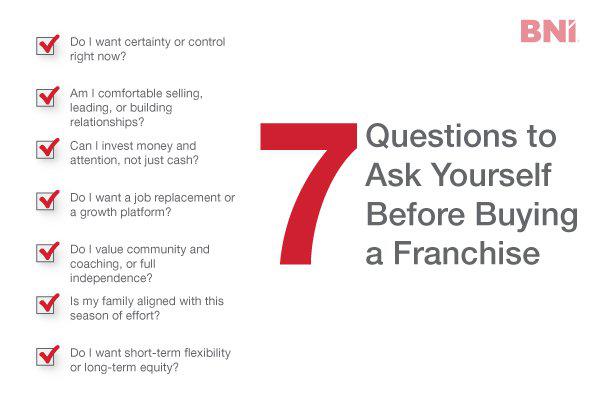
Before you start looking at specific brands, you need to look inward. Honest answers to these seven questions will clarify if you are ready to make the transition from employee to owner.
1. Do I want certainty or control right now?
Context: Employment offers the illusion of certainty (a paycheck), while business ownership offers control.
If Yes: You are ready to trade the guarantee of a bi-weekly paycheck for the unlimited potential of building your own revenue stream.
If Not Yet: You may value the perceived safety of a traditional job over the responsibility of steering the ship.
2. Am I comfortable selling, leading, or building relationships?
Context: No business grows in a vacuum. Franchising requires interaction.
If Yes: You understand that business growth comes from connecting with people and leading teams. Brands like BNI thrive on this specific skill set.
If Not Yet: You might prefer a role where you can work in isolation behind a screen, which is rarely the reality of franchise ownership.
3. Can I invest money and attention, not just cash?
Context: A franchise is not a passive investment like a stock; it requires your focus.
If Yes: You are prepared to allocate time, energy, and financial resources to nurture the business during its ramp-up phase.
If Not Yet: You are looking for a “set it and forget it” investment, which is not what active franchise ownership entails.
4. Do I want a job replacement or a growth platform?
Context: Some buy a franchise to “buy a job.” Others buy it to build an enterprise.
If Yes: You view the franchise as a vehicle for scaling wealth and impact, not just a place to go from 9 to 5.
If Not Yet: You are looking for a lateral move to simply replace your current salary without the headache of scaling.
5. Do I value community and coaching, or full independence?
Context: Franchising is being in business for yourself, but not by yourself.
If Yes: You appreciate a structured system, peer support, and a proven playbook.
If Not Yet: You’re drawn to full independence right now, building something entirely your own, on your own terms. You value creative control and flexibility, even if it means figuring things out as you go.
6. Is my family aligned with this season of effort?
Context: Business ownership impacts the whole household.
If Yes: Your spouse or partner understands the short-term focus required to build long-term freedom.
If Not Yet: There is friction at home regarding risk or time commitment that needs to be resolved first.
7. Do I want short-term flexibility or long-term equity?
Context: Startups require upfront work to create downstream freedom.
If Yes: You are willing to work hard now to build an asset that generates recurring value later.
If Not Yet: You prioritize immediate free time over the construction of future wealth.
Who Franchise Ownership Is Especially Well-Suited For in 2026
The landscape for 2026 favors specific types of professionals who can leverage their past experiences into business success.
- Corporate Refugees: Professionals in transition who have high-level management skills but are tired of corporate politics.
- Operators Who Want Ownership: Individuals who know how to run a P&L and manage teams but lack a product or system of their own.
- Sales Leaders: Those who have hit income ceilings in their current roles and want a vehicle where their earning potential is uncapped.
- Coaches & Consultants: Relationship-driven professionals who want to monetize their ability to connect and mentor others.
- Multi-Business Entrepreneurs: Investors looking for a growth engine to add to their existing portfolio.
Common Myths That Hold High-Quality Buyers Back
Even qualified candidates often hesitate due to misconceptions. Let’s reframe the most common myths.
- “Franchising is too expensive.”
- The Reality: Not all franchises require millions in liquid capital. Service-based models like BNI often have much lower barriers to entry than brands with physical locations or expensive equipment investment.
- “I need industry experience first.”
- The Reality: Franchisors provide the training. They look for leadership ability and soft skills, not necessarily industry-specific technical knowledge.
- “It’s too risky right now.”
- The Reality: Starting a business from scratch is high-risk. Buying a franchise like BNI with a 40-year track record of year over year growth can help mitigate some of that risk.
- “I’ll lose flexibility.”
- The Reality: While the launch phase requires focus, the ultimate goal of ownership is to gain control over your schedule.
- “It’s basically buying a job.”
- The Reality: Smart owners build teams and systems to eventually step out of daily operations.
What Makes a Franchise a Smart 2026 Bet

Not all franchise opportunities are created equal. As you evaluate your options for 2026, look for specific characteristics that signal resilience and growth potential.
The smartest bets for the coming year involve low overhead. High rent and heavy inventory can cripple a business during economic fluctuations. Look for models that are service-oriented or operate without expensive real estate.
Additionally, seek out recurring revenue models. Businesses that rely on memberships or subscriptions offer predictable cash flow, which is superior to chasing new one-off sales every month.
Finally, focus on relationship-based growth. In an AI-driven world, businesses built on human connection, trust, and community leadership will remain essential.
Where BNI Fits Into the 2026 Franchise Landscape
When you filter for low overhead, recurring revenue, and relationship-based growth, BNI stands out as a unique opportunity in the franchise landscape.
Unlike traditional retail and restaurant franchises, BNI ownership is not about managing inventory or deep fryers. It is a brand built on relationships, a recurring membership model, and community leadership. As the world’s leading business networking and referral organization, BNI offers a model that is scalable through territory ownership.
This is an ideal fit for leaders, connectors, and growth catalysts who want to facilitate success for others while building a robust business for themselves. It leverages the very thing that technology cannot replace: the power of trusted human relationships.
How to Explore Franchise Ownership Without Committing Yet
You do not need to sign a contract to start learning about the franchise opportunity with BNI. The best approach is “education first.”
Engage in discovery calls with the franchise development team. These are not high-pressure sales pitches; they are mutual validation conversations designed to see if there is a cultural and financial fit. Then, attend a “Meet the Team” day and speak with existing franchisees to understand the day-to-day reality of owning a BNI franchise.
Good due diligence means asking hard questions and getting clear answers before you ever spend a dollar.
2026 Is a Planning Year—Not a Guessing Year
Owning a franchise isn’t the right move for everyone. It requires grit, leadership, and a willingness to follow a system. However, clarity always beats hesitation. Whether the answer is “yes, now is the time” or “not yet,” the process of exploration is a win within itself.
If you are looking for a business model that champions collaboration, provides a recession-resilient structure, and allows you to lead within your community, it is time to start the conversation.
Start a confidential discovery conversation with the BNI team today and see if franchise ownership fits your 2026 goals.