

Franchise ownership is often viewed through a narrow lens, commonly described as either “buying a brand” or “buying a job.” While those phrases are easy shorthand, they don’t fully capture what franchise ownership actually represents. At its core, franchising is a form of structured entrepreneurship, one that blends the independence of business ownership with the support of a proven system.
Many service-based franchises challenge traditional assumptions about what ownership looks like. Models that are relationship-driven and low overhead, like BNI, offer a different kind of opportunity, one centered on leadership, community-building, and long-term value creation. This article explores what franchise ownership truly means, how the franchise business model works, and how service-based franchises fit into today’s entrepreneurial landscape.
What Is Franchise Ownership, Really?
At its heart, franchise ownership means operating your own business within an established and tested framework. As a franchisee, you are the owner and leader of your local business. You are responsible for growth, execution, and building a strong team and customer base. Rather than simply managing day-to-day activity, you are developing an asset with long-term potential.
The franchisor’s role is to provide the foundation that supports that ownership: the brand, operational systems, training, and ongoing guidance. This creates a partnership where the franchisor supplies the blueprint and the franchisee brings leadership, accountability, and local insight.
In a service-based franchise like BNI, ownership looks a little different from traditional retail concepts. There is no physical inventory or storefront. Instead, the business is built around leadership, facilitation, and the ability to cultivate strong professional communities. Relationships, credibility, and consistency become the core drivers of value.
How the Franchise Business Model Works in Practice
The franchise business model is built on a clear value exchange. Franchisees pay an initial investment and ongoing fees in return for access to the franchisor’s brand, systems, and intellectual property. The goal is to shorten the learning curve and reduce the uncertainty that often comes with starting a business independently.
A strong franchisor provides comprehensive support, including initial training, operating frameworks, marketing resources, and ongoing coaching. This support evolves over time, helping franchisees navigate challenges and scale their businesses more effectively.
BNI operates on a recurring revenue model centered on chapter membership. Its systems have been refined across global markets, giving franchisees a structured approach to launching and growing networking chapters. With centralized tools and local ownership working together, franchisees can focus on leadership, member experience, and sustainable growth.
Buying a Franchise vs. Starting from Scratch
Entrepreneurs typically face two paths: building something entirely new or building on an established foundation. Starting an independent business often involves developing a concept, creating a brand, building systems, and testing the market through trial and error. While this path offers creative freedom, it can also involve higher uncertainty and longer timelines.
Buying a franchise provides a more direct route to execution. The concept has already been validated, and many of the foundational pieces are in place. With a franchise like BNI, there is no product to invent or physical location to manage. The need for business networking and referrals exists in every market, creating consistent demand.
This structure allows franchisees to focus their energy on leadership and growth from day one. The expectations are clear, the systems are proven, and individual effort is supported by a globally recognized brand.
Common Franchise Ownership Myths
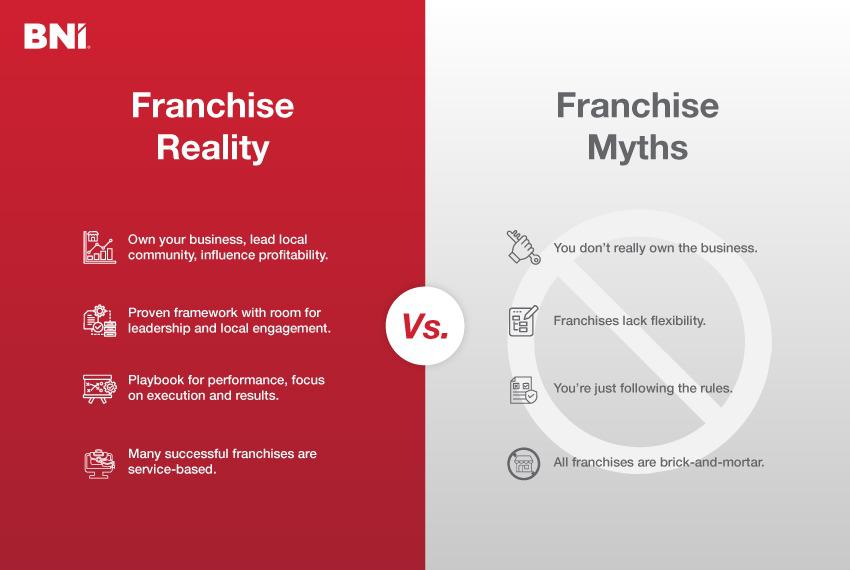
Several myths can obscure what franchise ownership actually involves. Looking at them more closely helps clarify how service-based franchises operate.
Myth: “You don’t really own the business.”
Reality: Franchisees own their business within a defined territory. BNI franchise owners build and grow local business communities and make strategic decisions that directly influence performance and profitability.
Myth: “Franchises lack flexibility.”
Reality: Franchising provides structure, not rigidity. Franchisees have room to lead their teams, engage their local markets, and apply their strengths within a proven framework.
Myth: “You’re just following rules.”
Reality: Franchise systems are designed to support execution. Much like a playbook in sports, the framework helps owners focus on performance, consistency, and results.
Myth: “All franchises are brick-and-mortar.”
Reality: Many successful franchises today are service-based, with no storefront, inventory, or large staff requirements.
Who Is Best Suited For Franchise Ownership
Franchise ownership appeals to entrepreneurs who value structure and want to focus on execution rather than invention. It tends to work especially well for individuals who enjoy leading people, building relationships, and growing within an established system.
BNI franchisees are typically growth-oriented, community-minded leaders who appreciate coaching, collaboration, and scalability. They are interested in service-based ownership that allows them to build something meaningful without having to design every element from scratch.
Like any business model, franchising works best when there is alignment between the owner’s strengths and the system itself. Understanding that alignment is a key part of evaluating any franchise opportunity.