


Most franchise conversations still default to the same handful of categories: fast food, fitness studios, home services, retail. These are the models most people picture when they hear the word "franchise," largely because they're the ones built around a storefront or a truck, the ones you can see on a drive down Main Street.
But a different category has been growing steadily in the background, attracting less attention while quietly outperforming many consumer-facing models on the metrics that matter most to owners: overhead, retention, and long-term revenue stability. That category is business-to-business, or B2B, franchising.
As more prospective owners look past the obvious options and dig into what actually drives profitability, B2B franchise models are earning a closer look.
What Makes a Franchise "B2B"
A B2B franchise sells its product or service to other businesses and professionals rather than to individual consumers. Instead of competing for foot traffic or one-time purchases, these franchises build ongoing relationships with a client base that returns, renews, and refers.
This category spans a wide range of models, from commercial cleaning and staffing to marketing services, consulting, and professional networking organizations. What ties them together isn't the specific service. It's the buyer. Businesses tend to make decisions more deliberately than individual consumers, value consistency over novelty, and stay loyal to providers who deliver measurable results.
That difference in buyer behavior changes the entire shape of the business underneath it.
Why This Category Has Stayed Under the Radar
B2B franchising hasn't gotten the same visibility as consumer brands for a fairly simple reason: it doesn't advertise to the public. A B2B franchise owner isn't running television spots or competing for walk-in traffic, so these businesses are largely invisible to anyone outside the industries they serve.
That lack of visibility has created a gap. Search interest in franchising still skews heavily toward recognizable consumer categories, even though many B2B models post stronger unit economics. For prospective owners willing to look past brand recognition, that gap represents an opportunity: less competition for information, and often less competition for territory.
The Structural Advantages of B2B Franchise Models
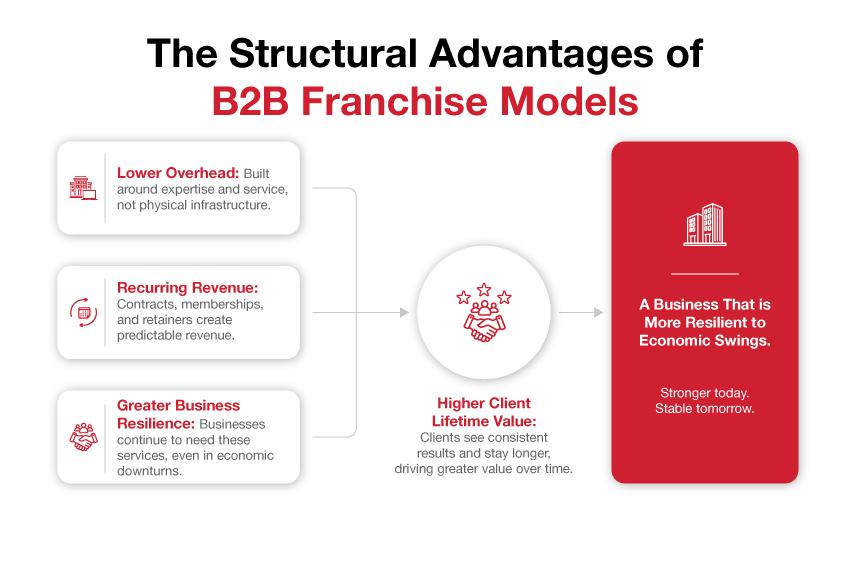
Several characteristics show up consistently across strong B2B franchises, and they explain why the category is drawing more serious interest.
Lower overhead is one of the most immediate differences. Many B2B franchises don't require a retail lease, inventory, or a large staff of hourly employees. The business is built around expertise, relationships, and service delivery rather than a physical location designed to attract walk-in customers.
Recurring revenue is another. Business clients frequently engage on contracts, memberships, or retainers rather than single transactions, which means revenue is more predictable from month to month than in models that depend on constant new customer acquisition.
Higher client lifetime value follows naturally. A business client that sees consistent results tends to stay engaged far longer than an individual consumer comparison-shopping for the lowest price, and the relationship itself becomes part of the value being delivered.
Together, these traits produce a business that is often more resilient to economic swings. Companies still need the services that help them operate, compete, and grow, even when consumer discretionary spending tightens.
What to Look for in a Strong B2B Franchise
Not every business-to-business model is built the same way, so evaluating a B2B franchise means asking a specific set of questions.
Does the franchise generate recurring revenue, or does it depend on constantly replacing one-time clients? Is the value delivered ongoing, such as continued access, support, or results, rather than a single completed job? Does the model rely on relationships and trust, or on being the lowest-cost bidder for a one-time need? And does the franchise system provide a clear path to building a client base that compounds over time, rather than resetting with each new sales cycle?
Franchises that check these boxes tend to reward owners who are patient, relationship-oriented, and comfortable building a business through reputation rather than volume.
A Real-World Example: BNI as a Leading B2B Franchise
BNI is one of the clearest examples of what a strong B2B franchise looks like in practice. As the world's largest referral networking organization, BNI's entire model is built around helping business owners and professionals generate revenue for each other, which places it squarely in the B2B category by design, not by accident.
A BNI Franchise owner isn't selling to individual consumers. They're building and leading a professional membership community made up of business owners who pay recurring dues to participate in a structured referral system. That structure produces the traits that define a strong B2B franchise: low overhead, since the business requires no inventory or storefront; recurring, membership-based revenue rather than one-time sales; and a client base, in this case, Chapter Members, that grows more valuable to the owner the longer the relationships last.
BNI also illustrates a detail that's easy to overlook in the B2B category: retention isn't just a revenue metric, it's the actual product. Members renew because the referral relationships they build keep generating results, which means the owner's business gets stronger as the community around it deepens.
Why This Category Deserves a Closer Look
For prospective franchise owners, the appeal of B2B models isn't that they're easier. Building a business around relationships and recurring value still requires leadership, consistency, and patience. The appeal is that the underlying structure is built to reward those qualities rather than fight against them.
Consumer-facing franchises will always have a place, and plenty of them succeed. But for owners drawn to steady, compounding growth over foot traffic and constant promotion, the B2B category offers a model that's been quietly proving itself, one recurring client relationship at a time.
BNI stands out as a franchise built entirely on that principle, offering owners a way to lead a business-to-business model with four decades of proof behind it.
Ready to explore whether a BNI Franchise is right for you?
Start a conversation with our franchise development team