

At some point, most ambitious entrepreneurs ask the same question. Not "should I start a business?" — that part is settled. The real question is: how?
Building something from scratch has an undeniable appeal. You set the direction. You own every decision. There is no playbook to follow and no system to fit into. For some, that freedom is exactly the point. But for others — especially experienced professionals who have already built careers on leadership and relationships — the more interesting question is whether starting from zero is actually the most effective use of what they bring.
That is the question this post explores. Not which path sounds better, but which one is better designed for the outcome you are actually after.
What Starting an Independent Business Actually Requires
Building an independent business means building everything. The concept, the brand, the systems, the client base, the reputation — none of it exists until you create it. That is genuinely exciting. It is also genuinely hard.
The early phase of an independent venture is largely a problem of proof. You are testing whether the market wants what you are offering, whether your pricing holds up, and whether you can generate consistent revenue before the runway runs out. Many talented people with strong ideas spend years in this phase — not because they lack skill, but because the process of validating a new concept takes time that no amount of effort can fully compress.
The business you eventually build, if it succeeds, is entirely yours. But the timeline, the uncertainty, and the need to construct every operational element from scratch are real costs that do not always get weighed honestly in the decision.
What a Franchise Model Provides Instead
A franchise does not eliminate the work of business ownership. What it does is change the nature of that work from the first day.
Instead of building systems, you operate within an established global model that has already been refined across markets, economic cycles, and years of real-world performance. Instead of building a brand from scratch, you launch with global recognition behind you. Instead of learning by trial and error, you have access to dedicated franchise support — structured onboarding, ongoing coaching, and a network of experienced peers who have navigated the same challenges you are facing.
The tradeoff is a real one. In exchange for that foundation, you operate within a defined framework. Some entrepreneurs find that limiting. But many — particularly those who have spent careers executing within systems rather than inventing them — find it clarifying. The framework removes the noise and lets you focus on what actually drives results: leadership, relationships, and growth.
The Revenue Model Difference
One of the most meaningful distinctions between an independent business and a franchise like BNI is how revenue is structured.
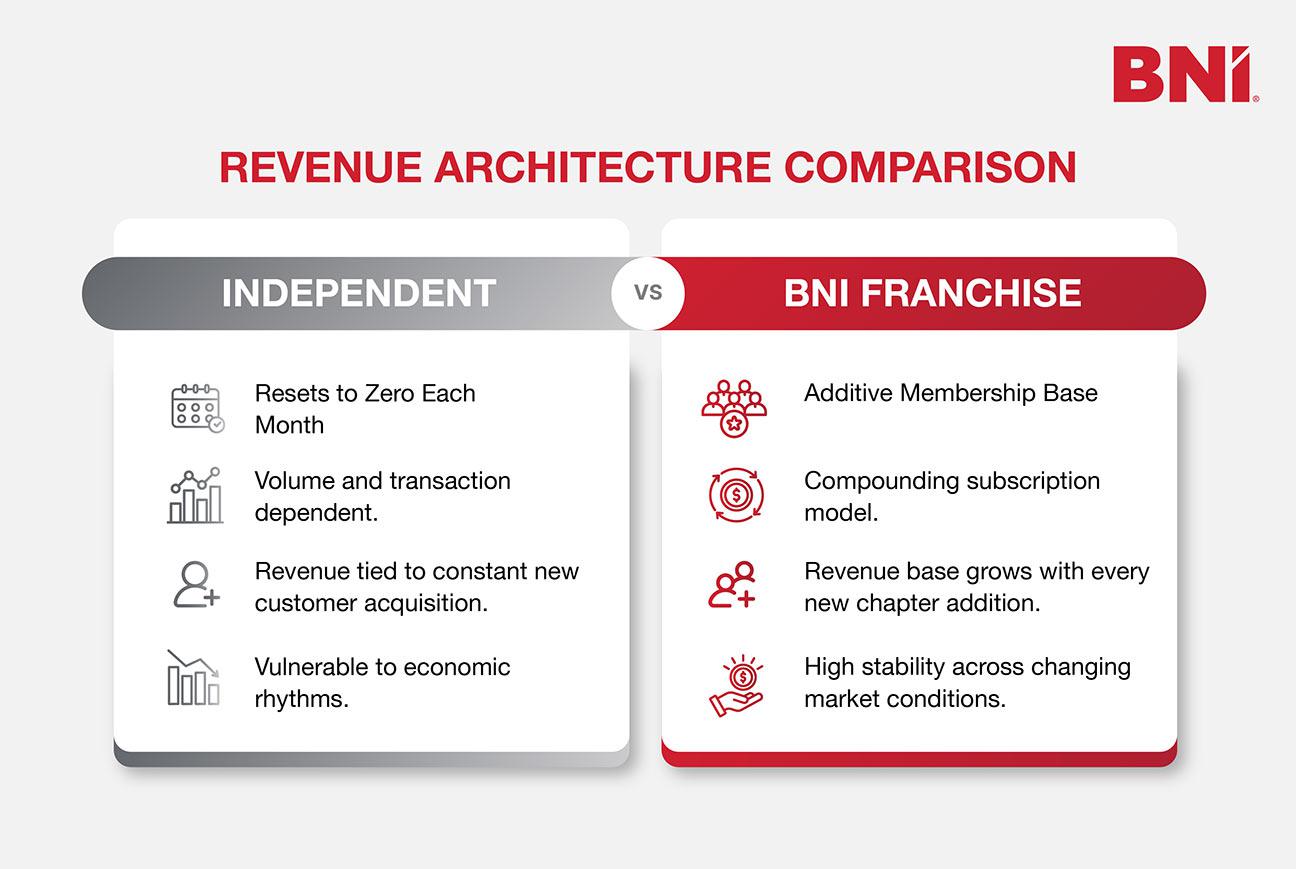
Most independent businesses start with a transaction-based model. Revenue depends on finding new customers, closing new deals, and generating consistent volume. Every month begins at zero. When business development slows — because of an economic shift, a personal situation, or simply the natural rhythm of a new venture — revenue slows with it.
BNI franchises operate on a recurring revenue model. Members commit to their Chapters on an ongoing basis, which means the revenue base grows with each new Member added and sustains itself through continued participation. Growth is additive rather than cyclical. That structural difference has real implications for how the business feels to run and how it performs across different economic conditions.
Combined with low overhead operational cost — no storefront, no inventory, no supply chain — the model is designed to remain healthy even when external conditions create pressure on other types of businesses.
Where the Comparison Gets Personal
Neither path is categorically better. What matters is fit.
Independent business ownership rewards creativity, tolerance for uncertainty, and the willingness to spend significant time in a proof phase before the model stabilizes. It is the right path for entrepreneurs who have a specific concept they believe in and the drive to build its foundations from the ground up.
A franchise like BNI is better suited for ambitious entrepreneurs who want to lead rather than invent — people who thrive when given a proven framework and a clear mandate to grow within it. The most successful BNI franchise owners tend to be relationship builders and community leaders by nature. The Givers Gain® philosophy — the principle that helping others grow their business ultimately grows your own — is not just a tagline. It is the operating culture of every Chapter, and it attracts Members who take that mindset seriously.
The Question Worth Asking
Before choosing a path, it helps to be honest about what you are actually optimizing for.
If the goal is creative control and the freedom to build something entirely original, an independent business is the more natural fit. If the goal is building a scalable, community-driven business with a proven model, best in class support, and a built-in community that accelerates growth behind you from day one — the franchise path, and BNI specifically, deserves a serious look.
Forty one years of global expansion across dramatically different economic conditions is not an accident. It is the result of a model that has been tested, refined, and proven in markets around the world. For the right entrepreneur, that track record is not a constraint. It is the point.
If you are evaluating your options and want to understand what BNI franchise ownership could look like in your market, our franchise development team is ready to have that conversation.